
If you’ve been struggling with chronic sinus infections or nasal polyps, your doctor may have mentioned Functional Endoscopic Sinus Surgery (FESS). Don’t let the medical name intimidate you, FESS is simply a modern, minimally invasive surgical technique designed to help you breathe easier.
Functional Endoscopic Sinus Surgery (FESS) works by gently enlarging the narrow passages in your sinuses, allowing them to drain properly and reducing infections. The beauty of this approach? The entire procedure happens inside your nose through your nostrils, no external cuts, no visible scars. Your surgeon uses a thin camera (called an endoscope) to see inside your sinuses and carefully remove tissue or bone blocking drainage pathways. The procedure is performed under general anesthesia, so you sleep through the entire operation.
Will There Be Bleeding During and After Functional Endoscopic Sinus Surgery?
Here’s an honest truth: yes, some bleeding is normal after Functional Endoscopic Sinus Surgery (FESS). But “normal” doesn’t mean alarming.
Because the surgery involves removing tissue and bone to clear blockages, mild bleeding and bloody nasal drainage for the first 5-7 days is completely expected. You might notice blood-tinged discharge when you gently dab your nose, this typically decreases each day. Severe bleeding complications are actually quite rare, occurring in only about 3 out of every 100 surgeries.
Your surgeon may place temporary packing inside your nose to help control bleeding. Think of it as gentle pressure to stop oozing, similar to what happens when you get a nosebleed. To prevent excessive bleeding at home, simply avoid blowing your nose, heavy lifting, and strenuous exercise during the first week. If you do experience steady bleeding, gently apply a nasal spray like Afrin or apply ice to the bridge of your nose while pinching it. Contact your doctor only if bleeding is heavy and doesn’t stop with gentle pressure.
Is the Procedure Actually Painless?
Here’s the best news: you won’t feel any pain during the surgery itself because you’ll be under general anesthesia, completely asleep.
After surgery? This is where a common myth gets busted. Many people expect Functional Endoscopic Sinus Surgery (FESS) to be agonizing, but the reality is quite different. Research shows that most patients experience only mild to moderate discomfort, nothing like the severe pain of older, open sinus surgeries.
In fact, studies find that the majority of patients report either no pain or only mild pain during their first five days of recovery. Most describe the discomfort not as sharp pain, but as a feeling of facial pressure, fullness, and nasal congestion, similar to a severe sinus infection or bad sinus headache. This sensation peaks around day 2-3, then steadily improves.
Interestingly, age plays a role: younger patients tend to report higher initial discomfort, while older patients often experience less pain. The good news is that this manageable discomfort responds well to simple over-the-counter medications.
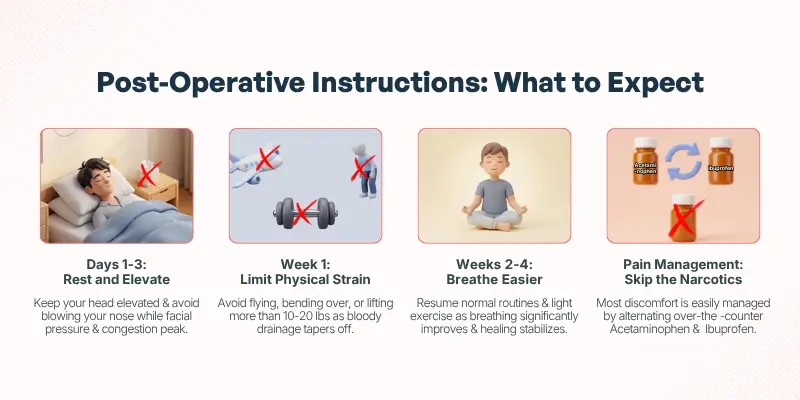
Post-Operative Instructions: What to Expect
Text: Recovery happens gradually. Most patients go home the same day as surgery and are back to light activities within one week. The first few days are the most important for healing.
Care Guidelines:
- Days 1-3: Rest with your head elevated, avoid blowing your nose, and limit activity. Facial pressure and congestion peak now, this is normal.
- Week 1: Take time off work. Avoid flying, bending over, and lifting anything heavier than 10-20 pounds. Bloody drainage usually stops by day 5-7.
- Weeks 2-4: Resume normal routines and light exercise. You’ll notice significant improvement in breathing, though taste and smell may still feel diminished.
- Beyond Week 4: Most daily activities are fine; strenuous exercise can restart at full intensity.
Attend all follow-up appointments (typically at 1, 3, and 6 weeks) so your surgeon can monitor healing and remove any crusts or clots, keeping your sinuses open and healthy.
Pain Management Options After Functional Endoscopic Sinus Surgery (FESS)
Pain Relief Option | Type | Effectiveness | Notes |
Acetaminophen | Over-the-counter | Very effective for mild-moderate pain | Take as directed; safe and gentle on stomach |
Ibuprofen | Over-the-counter | Very effective; reduces inflammation too | Alternate with acetaminophen for best relief |
Alternating Tylenol & Ibuprofen | Combined approach | Highly effective | Most patients use this successfully; space doses 3 hours apart |
Oral Steroids | Prescription | Reduces swelling and inflammation | Started day after surgery; helps significantly |
Narcotic painkillers | Prescription | Strong relief, but often unnecessary | Studies show narcotics are overprescribed; non-narcotic options work for most |
The key takeaway? You likely won’t need narcotic painkillers. Most patients manage beautifully with non-narcotic options. Your surgeon will prescribe oral steroids the day after surgery to reduce internal swelling, which is especially helpful if you have nasal polyps. Antibiotics are also prescribed to prevent infection while your sinuses heal.
Summary: What Really Happens
FESS is a game-changer for people tired of chronic sinus problems. Yes, expect some mild discomfort and bloody drainage for the first week, that’s part of normal healing. But severe pain? Unlikely. Most patients are pleasantly surprised at how manageable their recovery is, especially compared to outdated open surgery techniques.
The procedure offers real hope: clearer sinuses, easier breathing, and a significant improvement in quality of life with minimal downtime.
Ready to Breathe Easier?
If you’ve been living with chronic sinus issues, Functional Endoscopic Sinus Surgery (FESS) might be the solution you’ve been looking for. Dr. GVK Chaitanya Rao specializes in advanced sinus surgery and can walk you through the entire process, answering all your concerns. Schedule a consultation to discuss whether FESS is right for you, book your consultation with Dr. Chaitanya Rao at Dr. Rao’s ENT. Learn more in The Sinus Book
FAQs
Is Functional Endoscopic Sinus Surgery painful?
No, Functional Endoscopic Sinus Surgery is not painful during the procedure as it is done under general anesthesia. Post-surgery discomfort is usually mild to moderate.
How long does pain last after FESS?
Most patients experience mild discomfort for about 3–5 days after surgery, with symptoms like pressure and congestion improving gradually within a week.
Is bleeding normal after Functional Endoscopic Sinus Surgery?
Yes, mild bleeding or blood-tinged nasal discharge is normal for 5–7 days after surgery and usually decreases over time.
How long does it take to recover from FESS?
Most patients return to light activities within a week and fully recover within 2–4 weeks, depending on healing and follow-up care.
What medications are used for pain after FESS?
Pain is usually managed with over-the-counter medications like acetaminophen and ibuprofen. Strong painkillers are rarely needed.
When can I resume normal activities after sinus surgery?
You can resume light activities within a week and gradually return to normal routines, including exercise, within 2–4 weeks.