
In my years as an ENT specialist, I have observed a striking trend: our noses are increasingly becoming the silent casualties of the modern world. Every day in my clinic, I meet patients who are highly productive but feel physically drained. They have come to accept nasal congestion, facial pressure, and persistent fatigue as the “new normal”—common sinus problems that often go unnoticed until they begin to affect daily life.
We are living in time where long hours in air-conditioned offices, exposure to urban pollution, and sedentary habits have created what I call a “Modern Sinus Tax.” This post is designed to bridge the gap between our current lifestyle struggles and the precision of modern medical solutions, helping you make informed decisions so you can breathe well and live better.
The Hidden Cost of Our "Air-Conditioned" Comfort
While we appreciate the comfort of a climate-controlled office, your nasal lining may disagree. Inside your nose, you have curved structures called turbinates, nature’s internal air conditioners. Their primary job is to warm and humidify the air before it reaches your lungs.
Modern air conditioning (AC) strips the air of its natural moisture, forcing the turbinates to work overtime. When they are constantly “shocked” by dry, artificial air and urban dust, they become swollen and inflamed. I often find that patients miss this environmental connection, assuming they simply have a “cold that won’t go away.” In reality, your turbinates are struggling to maintain the delicate mucosal balance your lungs require.
“Today’s lifestyle – with increasing pollution, sedentary habits, and long hours in air-conditioned environments – has led to a rise in these issues.”
Your Mucus Color is Telling a More Complex Story
One of the most common misconceptions I encounter is that green or yellow mucus automatically requires a round of antibiotics. The reality is far more nuanced. While pus-like yellow discharge often indicates bacterial sinusitis, fungal infections have a distinct clinical signature.
Fungal discharge is frequently described as “highly viscous” with a texture similar to “mud” or “cheesy, clay-like” mucus, often appearing greenish-black. Self-medicating with antibiotics in these cases is a significant mistake. Not only are antibiotics ineffective against fungi, but they can actually worsen the situation by killing off beneficial bacteria that keep fungal growth in check. Distinguishing between the “bacterial” and “fungal” signature is the first step toward the right treatment.
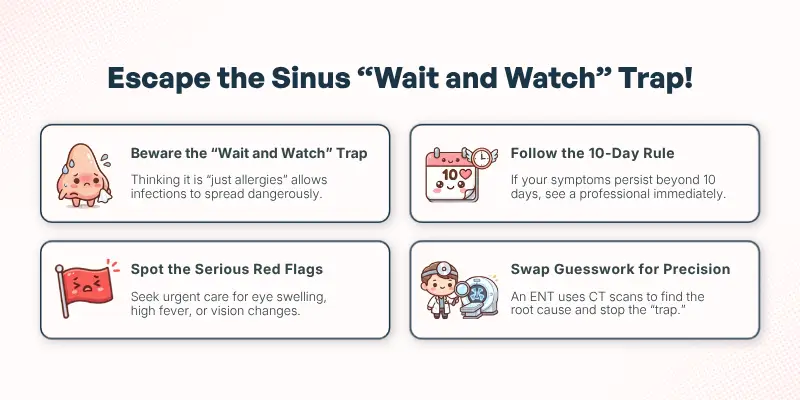
The "Wait and Watch" Trap and the 10-Day Rule
I often see patients who believe their recurring blocks and headaches were “just allergies.” They chose to “wait and watch” even as the pressure mounted. By the time they reach my clinic, they have severe eye swelling; the infection had spread beyond the sinuses into the orbital tissues, requiring immediate surgery.
The rule I teach my patients is simple: if symptoms persist beyond 10 days, it is time to seek professional help. To keep yourself safe, you must be aware of “Red Flag” symptoms that require immediate medical attention:
- Severe swelling or redness around the eyes
- Double vision or decreased vision
- Severe headache with fever and neck stiffness
- Severe facial pain with high fever
- Confusion or an altered mental state
Surgery isn’t a "Temporary Fix"
A persistent myth in rhinology is that sinus surgery provides only temporary relief. In my practice, I use a modern analogy to explain the truth: surgery is like building a high-speed highway.
Chronic inflammation, structural blockages, or polyps act like roadblocks, preventing medications, such as sprays and rinses, from reaching the deep sinus cavities. Surgery clears these obstructions and widens natural drainage pathways, allowing your treatments to finally reach their destination and work effectively.
“Surgery is not a ‘cure’ by itself. Think of it as creating a highway that allows your medications to reach exactly where they’re needed.”
We have moved far beyond the invasive “open” surgeries of the past. Today, we use Navigation-Guided Surgery (essentially GPS for your sinuses) to operate with millimeter precision and Balloon Sinuplasty to gently expand sinus openings with minimal downtime.
The Silent Connection Between Blood Sugar and Sinus Health
If you are living with diabetes, your sinus health requires extra vigilance. There is a precise mechanical reason for this: high blood sugar makes the fluid in your sinuses significantly thicker. This thickened fluid creates a heavy burden for the cilia, the tiny hair-like structures that act as your nose’s cleaning team, making them sluggish and ineffective.
This creates a sugar-rich breeding ground for fungi. In uncontrolled cases, this can escalate into Acute Invasive Fungal Sinusitis (AIFS), a medical emergency where the fungus attacks tissue, bone, and blood vessels. With mortality rates for AIFS ranging from 20% to 50%, every hour counts. This is why I advocate for a collaborative care model; managing your sinuses often requires a partnership between your ENT specialist and your Diabetologist to ensure your “internal cleaning team” stays active.
"I Wish I Had Known This Earlier"
The most rewarding moment in my clinic is when a patient sees their CT scan or Nasal Endoscopy for the first time. For years, they may have felt frustrated by invisible symptoms. A CT scan provides a “3D map,” showing exactly where the Osteomeatal Complex, the critical drainage pathway of the sinuses is blocked.
Seeing this “root cause” changes the patient’s perspective from frustration to a clear plan of action. Whether we see a deviated septum or a blocked pathway on the screen, having this clear data is what allows us to move from guesswork to precision medicine.
Conclusion
While our modern environment presents unique challenges, from air-conditioned dryness to urban pollution, the medical solutions available today are more precise and less invasive than ever before. We no longer have to settle for a “half-life” of headaches and fatigue.
By understanding the triggers in your environment, respecting the 10-day rule, and utilizing modern diagnostics, you can reclaim your quality of life. I ask you to consider this: What would breathing well change about your daily productivity or your ability to enjoy the simple moments of your life?
FAQs
What are the most common causes of sinus problems?
Common causes include allergies, air pollution, infections, prolonged exposure to air conditioning, nasal structural issues, and chronic inflammation.
Can air conditioning worsen sinus problems?
Yes. Air conditioning reduces humidity levels, which can dry out and irritate the nasal passages, leading to inflammation and congestion.
How does pollution affect sinus health?
Pollutants and airborne irritants can inflame the nasal lining, increase mucus production, and worsen existing sinus conditions.
What is the difference between bacterial and fungal sinus infections?
Bacterial sinus infections often produce yellow or green mucus, while fungal infections may cause thick, sticky, or clay-like discharge that can appear greenish-black.
When should I see a doctor for sinus problems?
Consult an ENT specialist if symptoms persist for more than 10 days, frequently recur, or include severe facial pain, fever, or difficulty breathing.
Can lifestyle changes help prevent sinus problems?
Yes. Staying hydrated, using a humidifier, reducing exposure to pollutants, exercising regularly, and maintaining good indoor air quality can improve sinus health and reduce symptoms.